
Starting an Online Store in Syria: From Product Listing to Delivery
Starting an Online Store in Syria: From Product Listing to Delivery
Short answer: An online store for customers in Syria is ready to take a first order when the product listing is accurate, stock can be checked, delivery areas and charges are clear, and the seller can confirm an eligible payment arrangement. A social inbox may be enough to test a small, simple offer. A structured storefront becomes useful when keeping product options, availability and orders straight by message becomes difficult.
This guide follows one clearly fictional Syrian seller from product listing to delivery. It focuses on the operating decisions behind a first order—not on a particular platform, payment promise or sales result.
Fictional example: Rima runs a small workshop selling olive-oil soap in Syria. She is preparing a few scents and sizes for her first online orders. The products, business and order below are illustrative; they do not describe a real merchant.
When are messages enough, and when is a store useful?
Direct messages can be a sensible starting point if the offer is small, each order is easy to confirm, and the seller can reliably record the chosen item, quantity, delivery area and payment arrangement. A simple order sheet can prevent details from being lost between conversations.
A storefront is worth considering when customers need to compare several products or variants, availability changes often, the same questions are repeated, or the seller needs one consistent record of incoming orders. A website does not automatically solve stock, delivery or customer-service problems; those processes still need an owner and a routine.
Choose a selling setup by testing the whole order
Use this decision aid to compare the work each route requires. Before paying for a platform or custom build, test a complete sample journey on a phone: find an item, understand its availability, place a non-payment test order, see the delivery details and learn how confirmation works.
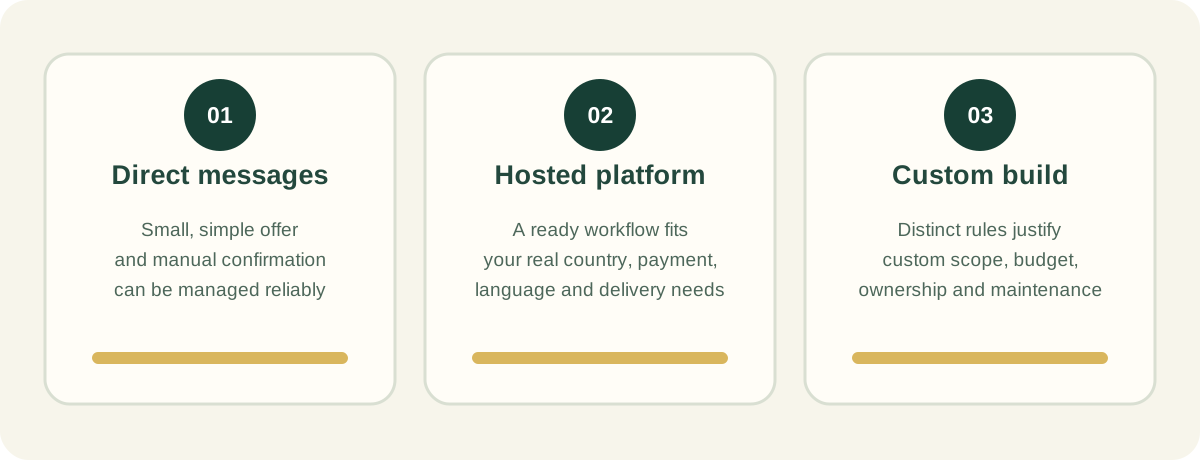 Decision aid: compare the work and constraints each selling route brings.
Social messages and a manual order log
Useful when: The catalogue and order flow are simple enough to confirm one conversation at a time.
Check before committing: Who updates stock, checks each order, calculates delivery and follows up if a detail is missing?
Hosted storefront
Useful when: You want an existing store workflow and the available features fit the way you sell.
Check before committing: Can the provider onboard your actual business location and activity? Check language and RTL support, total fees, currency and settlement, delivery options, account access, data export and exit terms.
Custom online store
Useful when: A documented business need cannot be handled well by the available hosted options or needs a specific integration.
Check before committing: Who will maintain the site, security updates, catalogue, backups and integrations after launch? Agree scope and ongoing responsibilities first.
Do not choose by popularity alone. A platform is not a fit if the merchant cannot lawfully and practically open the required account, receive settlement, manage delivery, or keep access to its own catalogue and order history.
Prepare product information customers can act on
Rima first separates the product itself from its options. Each item needs a distinct name and a reliable way to identify its variant. Before publishing, agree who changes the listing when a batch sells out or a price changes.
Illustrative product-page example — fictional details, not a live offer
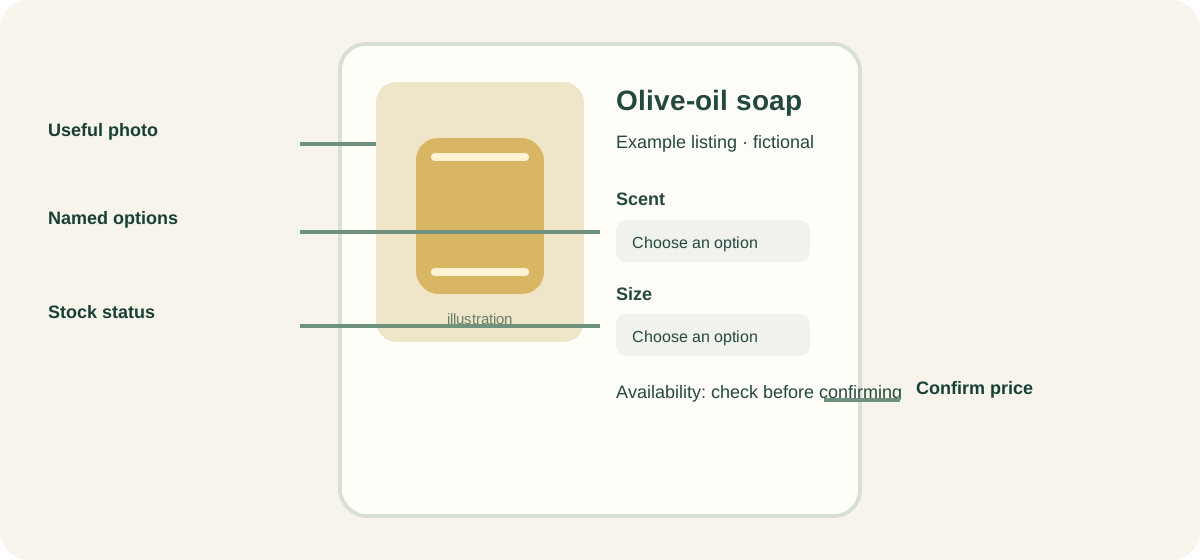 Product name: Olive-oil soap bar — example only
Options: Fragrance-free or lavender; show the size or weight for each option
Photographs: Use an accurate image of the item and packaging; add another view when it answers a real question
Price and currency: [Enter the amount and currency the seller actually accepts]
Availability: [In stock / made to order / temporarily unavailable — verify before confirming]
Next step: Choose an option, then request or place an order using the seller’s confirmed process
Use photographs that represent the colour, size and condition customers will receive. Keep product names, variants, units, prices and stock consistent between the catalogue and the order record. If stock is not synchronised, say that availability will be confirmed before the order is final.
Make delivery information specific before accepting the order
Delivery coverage, service and charges depend on the seller’s own arrangement. Confirm them with the carrier or delivery partner serving the intended areas; do not copy another shop’s coverage or estimate. A customer should be able to see which locations are served, how the fee is calculated and when the seller will confirm timing.
Reusable delivery-information example
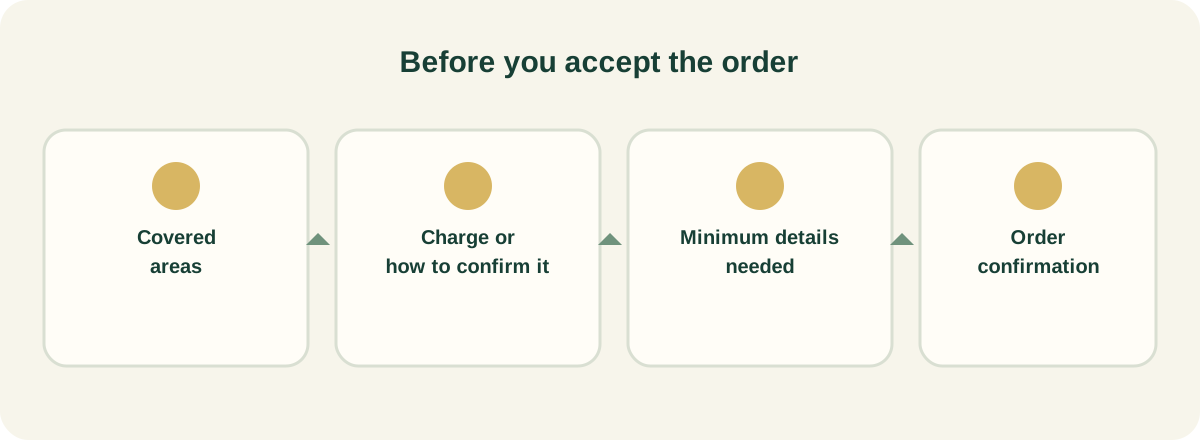 Areas served: [List the cities, districts or delivery zones actually covered]
- Delivery charge: [State the verified charge for each zone, or explain how it will be confirmed]
- Timing: [Give only a window the seller has checked; otherwise say when it will be confirmed]
- Details needed: [Collect only the contact and location details needed to fulfil the order]
- Payment: [List only methods the seller and customer can actually use for this order]
- Confirmation: [Explain how the seller will confirm stock, total amount and dispatch]
Ask only for information needed to contact the customer and complete delivery. Limit access to order details to people who need them, and explain how customers can ask about or change their order.
Check payment eligibility before designing checkout
Payment feasibility is not determined only by what a customer can use. The seller’s legal entity and operating location, business activity, provider rules, identity documents, settlement account, currencies, fees, refunds and dispute process can all matter. Confirm the actual merchant account, settlement route and customer journey before choosing a checkout integration.
If a business is located or operating from Syria, it should not assume that a provider will onboard it because the provider’s customers or cardholders are elsewhere. For example, Stripe’s current policy lists Syria under “High-risk jurisdictions and persons” and states that dealings or sales involving such jurisdictions are prohibited, directly or indirectly. Check the current policy and eligibility directly before designing a payment flow. Do not use another person’s account or misstate the merchant’s location to work around eligibility.
Possible arrangements—such as payment on delivery, a locally available transfer or an electronic payment provider—are only options to evaluate. Offer one only after the seller and customer can use it, the terms are understood, and the seller can reconcile payment with the order. Provider eligibility and local requirements can change; obtain current guidance from the provider and a qualified local adviser where needed.
Follow one order from first view to delivery
Rima writes down what must happen before she accepts real orders. The diagram is a practical checklist; it does not assume that every shop needs an automated checkout.
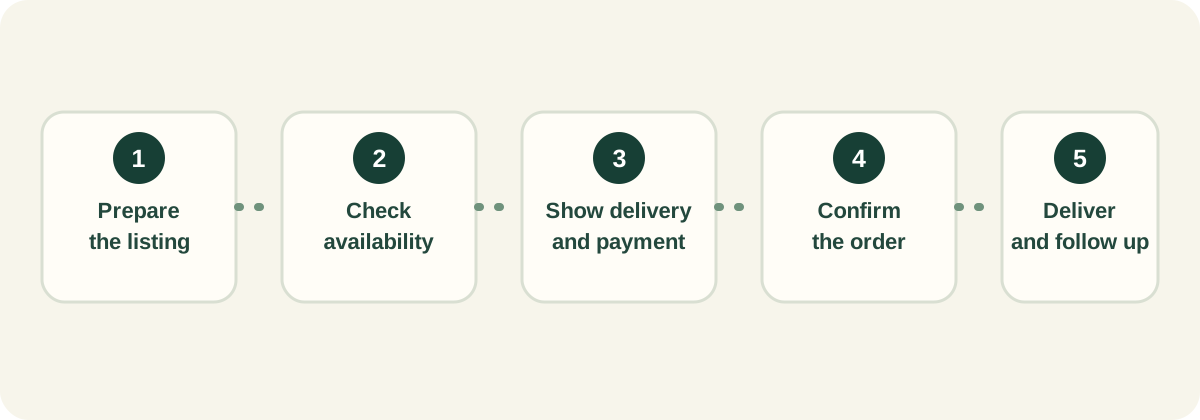 Illustrative order flow from product information through delivery.
- Discover: The customer reaches the product through a social post, a search result or a shared link.
- Choose: The listing identifies the item, variant, current availability, price and next step.
- Request: The customer provides the minimum contact and delivery-area details needed to continue.
- Check: The seller verifies stock, delivery coverage and charge, payment method and total.
- Confirm: The seller sends the confirmed details and explains what happens next. A request is not treated as accepted until this check is complete.
- Fulfil and record: The seller packs, hands over and marks the order’s final state—delivered, cancelled or returned—in the same order log.
Example confirmation message: “We received your request for [item and option]. We are checking availability and delivery to [area]. We will confirm the total, available payment method and expected dispatch window before preparing the order.” Replace the placeholders only with verified details.
Set expectations for cancellations, returns and questions
Before launch, write a short, visible process for changing or cancelling a request, reporting a problem, and asking about a return. State the contact channel and the information the customer should include. Decide who handles each message and how the order record is updated so the catalogue, seller and customer do not disagree about its status.
Do not assume a store’s wording replaces the rules that apply to the seller. Check current obligations for the business and the places where it sells with an appropriate local authority or qualified adviser. Keep the public policy consistent with the actual fulfilment process.
Pre-launch checklist for the first order
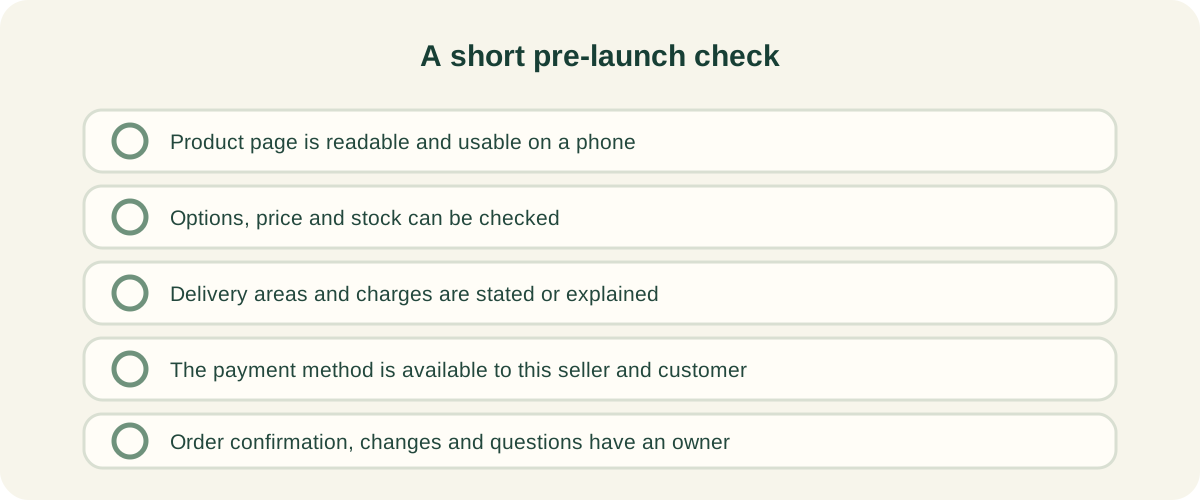 A visual reminder of the checks to complete before accepting orders.
- Every product has an accurate name, image, option, price basis and availability status.
- One person owns stock updates and knows when an order is confirmed.
- Delivery zones, charges, timing and customer details have been checked with the real fulfilment arrangement.
- Payment eligibility, settlement, fees and the reconciliation method are confirmed before offering a method.
- Customers can find cancellation, return and support instructions before ordering.
- A non-payment test order works on a phone, including a sold-out option and an unavailable delivery area.
- Order records show the product option, agreed total, delivery area, confirmation and final outcome.
- Product pages have clear titles, useful descriptions, descriptive image text and links that work without scripts.
Improve search visibility and learn from real orders
Give each product a descriptive name and a page that explains what it is, its options, availability and fulfilment. Keep important information in readable page text, use clear links between categories and products, and write accurate page titles. These are sound discovery and usability foundations, not promises of rankings or sales. Google’s Search Essentials and SEO Starter Guide explain its current public recommendations.
Begin with measures the seller can act on: enquiries or order requests received, the share that become confirmed orders, stock-related cancellations, delivery outcomes, common customer questions and the time needed to reconcile orders. Compare like periods and record changes in product or delivery arrangements. Search impressions and clicks, when Search Console is available, describe discovery; they are not the same as completed orders. Add analytics only after the business has deliberately chosen its measurement and privacy approach.
Frequently asked questions
Do I need a website before selling online?
Not necessarily. If a small offer can be handled accurately through messages and an order log, start there. Consider a storefront when customers need structured product choices or the manual workflow becomes difficult to maintain.
Can I add online card payments for a Syria-based shop?
Do not assume so. Check the current provider eligibility and settlement terms for the merchant’s real location, legal entity and activity. Stripe, for example, currently lists Syria under “High-risk jurisdictions and persons” in its policy, which states that related dealings or sales are prohibited directly or indirectly. Confirm alternatives directly with their providers before including them in a build.
What should I test before accepting the first order?
Run a non-payment test from a phone: select a product option, check availability, enter a delivery area, review the total and confirmation message, then record how the order would be fulfilled or cancelled.
Explore relevant next steps
For a project that needs a tailored storefront or order workflow, review Web Landscape’s web-development service. For a platform example, read the Tajerly case study and Tajerly service information. Web Landscape owns and operates Tajerly; it is one option to evaluate, not an independent endorsement, and features and integrations depend on plan and market. For a different question—the scope and cost of a business website—see the Syria website-cost guide.
Need to discuss the right setup for your catalogue and order flow? Tell Web Landscape about your online-store requirements. The contact form opens with web development selected; you can change it before submitting.
Sources and further reading
- Stripe: Prohibited and Restricted Businesses — check current eligibility directly with the provider.
- Stripe Support: Requirements to open an account in another country.
- Google Search Essentials.
- Google SEO Starter Guide.
